Last Words?
The Crumb Trail at Dusk

The end is near for R. Crumb. There’s no escape!
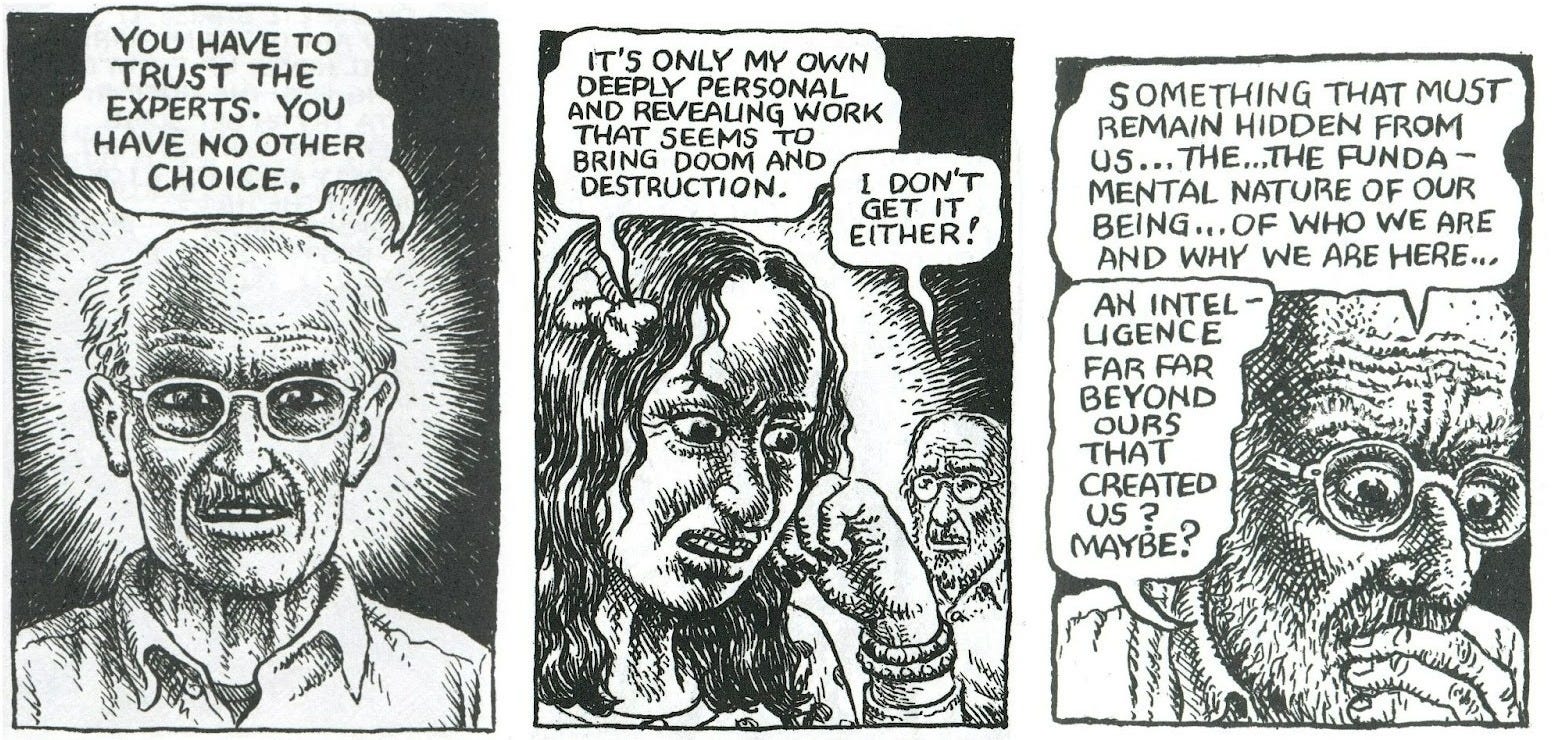
If you’re not familiar with his story, there’s a 50/50 chance you’ll dig it! Dan Nadel’s authorized CRUMB biography, released earlier this year, is a fantastic read, and I recommend it, but should you prefer to stay here a moment longer before going and ordering it, I’ll be brief. Robert Crumb’s been involved in making comics - cover to cover - since he was nine. That’s seventy-three years! He was inspired, and quite possibly harassed by his older brother Charles into making multiple issues annually throughout the late years of his childhood. His whole family suffered from a formidable web of individual and collective mental issues; his best course of action was to keep his head down and keep drawing. That eventually added up to so much drawing time that, on a skill level alone, he was ready to enter the workforce by the time he graduated high school. For several years, he made a living drawing greeting cards, and they were cute and saucy and zesty for their time. Still, there was always something more important about drawing comics. He sent his cartoons out for others to see, submitted them for publication. It was evident to anyone that read them he had something a little different. How could he not, being raised in such a bloodcurdling manner!
All these years later - good god, you might ask, what’s left?
Some kind of an answer was dropped in November, with R. Crumb’s first official comic book publication in twenty-three years, Tales of Paranoia. Now that it’s on newsstands everywhere, it’s clear to see that, as with all his work, it is meant to provoke questions. Big ones, bad ones, hard ones.
As terminally distressing as his vision is, I always look forward to reading a new Crumb comic. It’s a killer combo for me! His lustrous line (imparting, along with the mark on paper, a sunken investment of technique and historicity), and his deliriously unfiltered socio-political perspective has been too long away from the marketplace.
Once he started working in the early 1960s, Crumb freelanced with his cartoons for a couple years before taking it in hand as his own job of work. This meant, in a real reflection of the place and the time, him drawing enough strips to fill a twenty-eight page comic with no outside editorial constraints, then getting a dude that he met at a party to print the stuff. In February of 1968, Zap Comix sent a jolt through the cold, dead shadow of the Summer of Love. He and his wife sold it on the streets of San Francisco to anyone who’d pay a quarter for it. They soon drew interest at local stores and then with a local distributor and then nationally: these comics resonated with the people of that time right away. As R. Crumb, he spoke largely for himself, but as the best version of himself, the one designed to entertain. Zap’s confection was almost irresistible for the countenance of the time: ol’-timey cute and psychedelic imagery, shot through with adult humor, to amuse the adult AND the child in you. Unlike all the superhero, war and romance comics being pumped out every month, these comics had no code constraining them. That was a BIG part of it, the drugs and cussing and nudity and sex. And most of all, racist, sexist, classist ol’ America riposted in clear view, right where it stood. There was much to be gained by the naked honesty of putting it out there. Just reading the comic, you thought about where you stood.
So it was heavy and had hit a nerve - there was business to be done here! Viking called and offered a book deal, which Crumb took, even as he continued his life’s existential work: writing, drawing and publishing comics. Between ‘68 and ‘78, he made sixteen solo comic books and contributed work to dozens of others of underground comics in the industry that had sprung up around his own. The popularity of his work led to income from extra-comical items: the epochal “Keep On Trucking” licensed for shirts, posters and stickers, new drawings commissioned for magazines and album covers, a movie adaptation of “Fritz the Cat.” But it wasn’t THAT MUCH money. If he needed to, he could sell his sketchbooks and barter original art in exchange for things he wanted, like old 78rpm records. In this manner, everything that could be sold was sold, since a cartoonist’s living, especially one working in the name of his own peculiarly free speech, will go up and down. Like it says in the subtitle of the CRUMB bio: “A Cartoonist’s Life.”
Keep reading with a 7-day free trial
Subscribe to The Asking Tree to keep reading this post and get 7 days of free access to the full post archives.